

Dow Jones Forecast: Technical Analysis and Key Levels to Watch
Dow Jones Market Overview
The Dow Jones Industrial Average faced strong selling pressure this week as investors reacted to growing geopolitical tensions, shifting interest rate expectations, and broader market uncertainty. After posting gains earlier in the week, the index reversed sharply on Thursday, highlighting the fragile sentiment currently dominating global equity markets.
During Thursday’s session, the Dow Jones dropped 840 points, effectively erasing the gains recorded in Wednesday’s trading session. The sharp decline reflects a renewed wave of caution among investors as macroeconomic risks continue to influence market positioning.
Broad Market Weakness Across Major Indices
The sell-off was not limited to the Dow Jones. Major U.S. indices also recorded losses as risk sentiment weakened across the market.
The S&P 500 fell 0.82%, while the technology-heavy NASDAQ Composite declined 0.50%. This broad market decline suggests that investors are rotating away from high-risk assets amid rising global uncertainty.
Small-cap stocks were particularly vulnerable during the session. The Russell 2000 dropped 1.65%, indicating that investors are shifting toward more defensive sectors and safer investment strategies.
Geopolitical Tensions and Energy Market Risks
One of the key drivers behind the recent market volatility is the increase in geopolitical tensions. The continued closure of the Strait of Hormuz has raised concerns across global markets.
This strategic waterway handles approximately 20% of the world's oil supply, making it one of the most critical energy routes globally. Any disruption in this region can significantly affect oil prices and global inflation expectations.
Higher energy costs could place additional pressure on global economies, further increasing uncertainty in financial markets.
Federal Reserve Policy Expectations

Another major factor affecting market sentiment is the outlook for monetary policy from the Federal Reserve System.
Traders are gradually scaling back expectations for aggressive interest rate cuts this year. Rising energy costs and persistent inflation risks have led many market participants to anticipate only one potential rate cut during the year, compared to earlier expectations of multiple reductions.
This shift in expectations has contributed to increased volatility across equity markets and could continue to influence investor behavior in the coming months.
Dow Jones Technical Analysis
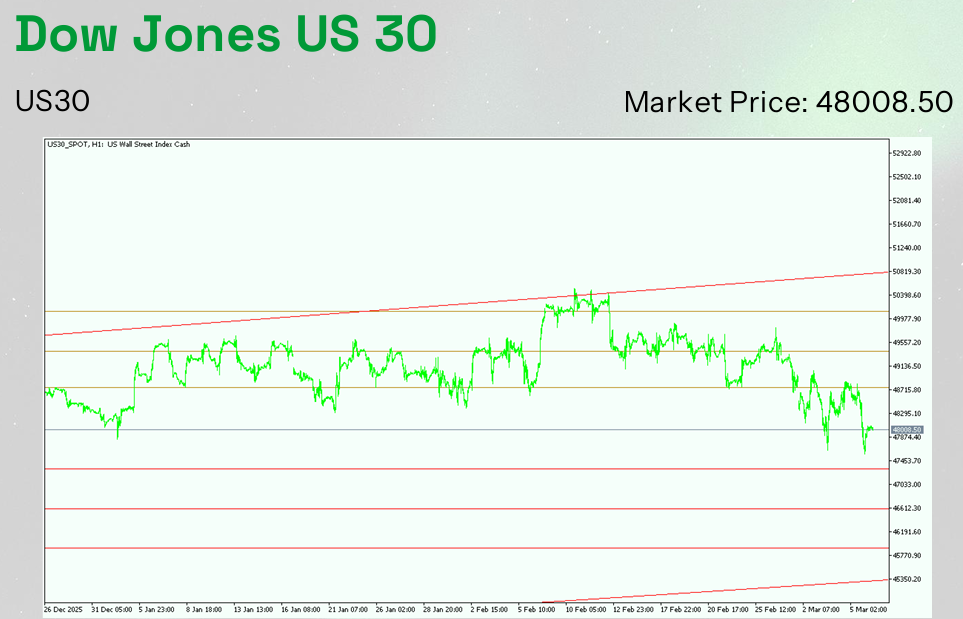
From a technical perspective, the Dow Jones is currently trading within a critical range defined by key support and resistance levels. Monitoring these levels can help traders identify potential breakout or breakdown scenarios.
Key Resistance Levels
- R1: 48,751.49
- R2: 49,399.29
- R3: 50,111.87
A breakout above 48,751.49 could signal renewed bullish momentum for the Dow Jones. If buying pressure continues, the next upside targets may appear near 49,399.29, followed by the psychological level around 50,111.87.
Key Support Levels
- S1: 47,310.15
- S2: 46,597.57
- S3: 45,901.19
On the downside, a break below 47,310.15 may increase bearish momentum. If selling pressure intensifies, the Dow Jones could decline toward 46,597.57, with the next major support level near 45,901.19.
Dow Jones Forecast and Market Outlook
Looking ahead, market volatility may remain elevated as investors closely monitor geopolitical developments, energy market dynamics, and signals from the Federal Reserve.
The Dow Jones remains highly sensitive to global economic conditions. Traders and investors should pay close attention to the key support and resistance levels identified in this analysis, as a decisive move beyond these levels could determine the next major trend for the index.
For now, the market environment suggests continued caution as investors balance risk exposure with defensive positioning.